Also on Bank Holidays UK: Public Holidays in Greece 2026 & 2027: Complete Guide for UK Travellers · Public Holidays in France 2026 & 2027: Complete Guide for UK Travellers · Public Holidays in Spain 2026 & 2027: Complete Guide for UK Travellers
GERMANY · PUBLIC HOLIDAYS · FEDERAL HOLIDAYS · 16 BUNDESLÄNDER · UK TRAVEL GUIDE
Public Holidays in Germany 2026: Complete Guide for UK Travellers
Germany has 9 federal public holidays in 2026 that apply nationwide, plus up to 5 additional regional holidays depending on the Bundesland (federal state). Bavaria observes the most (14), while Berlin, Hamburg and Bremen observe the fewest (10). This guide covers every date, what’s open and closed, and how the calendar compares with UK bank holidays — verified against the Bundesministerium des Innern and triangulated with Nager.Date.
Next public holiday
—
—
Updates automatically
Upcoming public holidays in Germany
The next German public holidays after 27 May 2026. Of the dates listed below, 9 are federal — they apply across all 16 Bundesländer. Regional holidays (observed only in some Länder) are flagged explicitly. Germany is the most regionally diverse country in Western Europe for public holidays, so always check the rules for the specific Land you're visiting.
| Date | Holiday | Type | Bridge / note |
|---|---|---|---|
| Thursday 4 June | Corpus Christi (Fronleichnam) | Regional religious (Catholic Länder) | Mid-week — pont possible by taking Friday off for 4 days in BW, BY, HE, NW, RP, SL |
| Saturday 15 August | Assumption Day (Mariä Himmelfahrt) | Regional religious (SL and Catholic Bavaria) | Falls on a Saturday — lost (Germany does not shift to Monday) |
| Sunday 20 September | World Children's Day (Weltkindertag) | Regional civil (Thuringia only) | Falls on a Sunday — lost in DE-TH |
| Saturday 3 October | German Unity Day (Tag der Deutschen Einheit) | National civil | Falls on a Saturday — lost (Germany does not shift to Monday) |
| Saturday 31 October | Reformation Day (Reformationstag) | Regional religious (Protestant Länder) | Falls on a Saturday — lost in the 9 northern/eastern Länder that observe it |
| Sunday 1 November | All Saints' Day (Allerheiligen) | Regional religious (Catholic Länder) | Falls on a Sunday — lost in BW, BY, NW, RP, SL |
| Wednesday 18 November | Repentance and Prayer Day (Buß- und Bettag) | Regional religious (Saxony only) | Mid-week — pont possible in DE-SN only |
| Friday 25 December | Christmas Day (Erster Weihnachtstag) | National religious | Natural 3-day weekend with Boxing Day |
| Saturday 26 December | Boxing Day (Zweiter Weihnachtstag) | National religious | Falls on a Saturday — lost, but back-to-back with Christmas Day |
Multi-year calendar — 2026, 2027, 2028
Germany's 9 federal public holidays across 2026, 2027 and 2028. Good Friday, Easter Monday, Ascension and Whit Monday are movable (Christian calendar) — the rest are fixed civil or religious dates. Germany has 9 federal holidays, slightly below the EU average (around 10–12), but Bavarian residents enjoy up to 14 once regional holidays are added.
| Holiday | 2026 | 2027 | 2028 |
|---|---|---|---|
| New Year's Day (Neujahr) | Thursday 1 January | Friday 1 January | Saturday 1 January |
| Good Friday (Karfreitag) | Friday 3 April | Friday 26 March | Friday 14 April |
| Easter Monday (Ostermontag) | Monday 6 April | Monday 29 March | Monday 17 April |
| Labour Day (Tag der Arbeit) | Friday 1 May | Saturday 1 May | Monday 1 May |
| Ascension Day (Christi Himmelfahrt) | Thursday 14 May | Thursday 6 May | Thursday 25 May |
| Whit Monday (Pfingstmontag) | Monday 25 May | Monday 17 May | Monday 5 June |
| German Unity Day (Tag der Deutschen Einheit) | Saturday 3 October | Sunday 3 October | Tuesday 3 October |
| Christmas Day (Erster Weihnachtstag) | Friday 25 December | Saturday 25 December | Monday 25 December |
| Boxing Day (Zweiter Weihnachtstag) | Saturday 26 December | Sunday 26 December | Tuesday 26 December |
⚠️ German holidays falling on weekends in 2026
Three federal holidays fall on a weekend in 2026: German Unity Day (Saturday 3 October) and Christmas/Boxing Day pairing (Friday 25 — Saturday 26 December). Like France and Spain and unlike the UK, Germany does NOT shift weekend holidays to a Monday — the day is simply lost. The silver lining for 2026: the strong cluster between 1 May and 25 May (three federal holidays in 25 days — 1 May, 14 May Ascension and 25 May Whit Monday, plus Easter weekend on 3–6 April) creates the most generous Brückentag (bridge day) season in years for German workers, and an excellent window for UK city breaks to Berlin, Munich or Hamburg.
What's open and closed for UK travellers in Germany
On German public holidays, banks, post offices and most administrations close — but more importantly for UK travellers, supermarkets and almost all shops close on Sundays AND public holidays by federal law (Ladenschlussgesetz). Tourist-facing Germany stays open — Biergärten, restaurants, museums and major train services keep running. The combination of Sunday closures plus Christmas markets, Oktoberfest and Berlin city breaks shapes most UK trips. Here's the practical breakdown:
| 🏦 Banks (Deutsche Bank, Commerzbank, Sparkasse, DKB, ING-DiBa, N26) | Closed on all 9 federal public holidays and on regional holidays in the relevant Land. ATMs (Geldautomaten) operate normally and UK cards (Visa, Mastercard, Revolut, Monzo, Starling, Wise) draw euros without issue — Wise and Revolut waive ATM fees up to a monthly limit. German branches typically open Mon–Fri with a long midday break in smaller towns. Online banking, SEPA transfers and the German GiroPay system work as usual on holidays. Note: Germany is still relatively cash-heavy by UK standards — carry €50–100 for Biergärten, bakeries and small shops. |
| 🛒 Supermarkets (Aldi, Lidl, Edeka, Rewe, Kaufland, Penny) | Closed on Sundays AND all public holidays by federal law — the Ladenschlussgesetz is one of the strictest in Europe. The only exceptions are petrol-station shops (Tankstellen), main train-station mini-markets (DB Rewe To Go in Hauptbahnhof) and airport retail. Berlin and a few cities allow up to 8 verkaufsoffene Sonntage (open Sundays) per year, but never on federal holidays. UK travellers must stock up on Saturday — this catches out almost every first-time visitor. Local bakeries (Bäckereien) open for 2–3 hours on Sunday mornings in most cities. |
| 🍽️ Restaurants, Biergärten, Konditoreien (everywhere) | Almost universally open on public holidays, including Sundays. German dining culture treats holidays as social occasions — Easter Sunday lunch, the long Christmas Eve dinner and Pfingsten (Pentecost) family meals are major traditions. Munich Biergärten (Hofbräuhaus, Augustiner-Keller, Hirschgarten) operate full hours on holidays from April onwards. Booking is essential in Berlin, Munich, Hamburg and Cologne, especially during Christmas markets and Oktoberfest. A handful of small Gaststätten close on Ruhetag (typically Monday) regardless of the holiday calendar. |
| 🚄 Deutsche Bahn trains (ICE, IC, RE, S-Bahn, U-Bahn) | Operating on a Sunday-style holiday schedule (Sonntagsfahrplan) with reduced frequency on regional routes. ICE high-speed services run roughly 80% of weekday frequency on major corridors (Berlin–Munich, Frankfurt–Cologne, Hamburg–Berlin). S-Bahn and U-Bahn city networks run reduced timetables. Direct UK booking via bahn.de or Trainline. Brexit note: no direct Eurostar to Germany — UK passengers change at Brussels-Midi for Frankfurt and Cologne (around 6h London–Cologne, 8h London–Frankfurt). The €49 Deutschland-Ticket covers all regional and city transport monthly. |
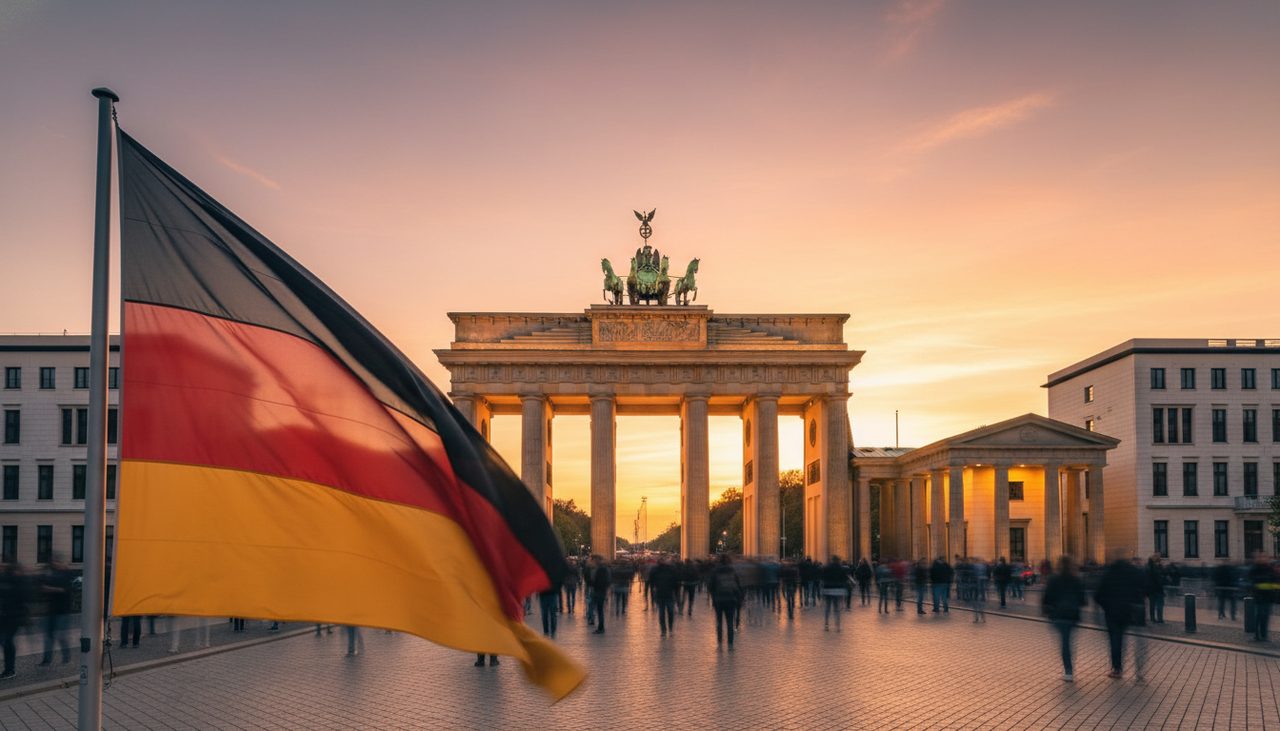
| 🏛️ Museums (Berlin Museumsinsel, Pinakotheken Munich, Pergamon, BMW Welt) | Most major German museums open on public holidays with Sunday hours. The Berlin Museumsinsel ensemble (Pergamon, Neues Museum, Alte Nationalgalerie) and Munich's Pinakotheken close on 1 January, 1 May, 24 and 25 December. Most museums close on Monday regardless — plan accordingly. The Brandenburg Gate, Reichstag dome (free, advance booking required), Berlin Wall Memorial and Munich's Marienplatz are accessible 24/7. Christmas market season (late November to 23 December) is the busiest UK travel window — Nuremberg, Cologne, Dresden and Munich are the most popular. |
| ✈️ Airports (Frankfurt FRA, Munich MUC, Berlin BER, Hamburg HAM, Düsseldorf DUS) | All operate 24/7 with full service on public holidays (FRA and MUC have night-flight curfews 23:00–05:00 year-round). The UK–Germany corridor is one of Europe's busiest business markets: easyJet, Ryanair, British Airways, Lufthansa, Jet2 and Eurowings all serve direct routes. Fares spike +50% during German school holidays (Bundesland-specific — check Berlin, Bavaria and NRW separately) and during Christmas markets (mid-November to 23 December) and Oktoberfest (mid-September to first weekend of October). Cheapest months from the UK: mid-January, late February and November. |
UK bank holidays that line up with Germany dates
For UK travellers planning a trip, certain combinations of UK bank holidays and German public holidays produce particularly good long-weekend opportunities. Internal cross-reference: see also our complete list of UK bank holidays for 2026.
| Period | UK side | Germany side | Trip tip |
|---|---|---|---|
| 3–6 April 2026 | Good Friday & Easter Monday (UK) | Karfreitag (Fri 3 Apr) + Ostermontag (Mon 6 Apr) | 4 days · perfect UK–Germany alignment — Berlin, Munich, Heidelberg or Black Forest Easter break |
| 1–4 May 2026 | Early May Bank Holiday (Mon 4 May) | Tag der Arbeit (Fri 1 May) | 4 days · Berlin city break, Rhine Valley castle cruises, Munich Maibaum (maypole) traditions |
| 14–17 May 2026 | UK weekend (no UK BH) | Christi Himmelfahrt (Thu 14 May) — also Father's Day in DE | 4 days with Friday off · Brückentag par excellence — book early, Germans travel heavily |
| 23–25 May 2026 | Spring Bank Holiday (Mon 25 May) | Pfingstmontag (Mon 25 May) | 3 days · perfect UK–Germany alignment — Hamburg, Cologne or Dresden without taking leave on either side |
| 4–7 June 2026 | UK weekend (no UK BH) | Fronleichnam (Thu 4 Jun) in Catholic Länder | 4 days with Friday off · Munich, Cologne or Freiburg — Catholic procession traditions |
| 2–5 October 2026 | UK weekend (no UK BH) | Tag der Deutschen Einheit (Sat 3 Oct) — lost | 3–4 days · late Oktoberfest closing weekend in Munich, Berlin Festival of Lights |
| 24 Dec 2026 – 3 Jan 2027 | UK Christmas + New Year | Erster + Zweiter Weihnachtstag (Fri 25 + Sat 26 Dec) + Neujahr (Fri 1 Jan) | 10–12 days · Nuremberg, Cologne or Dresden Christmas markets, then Berlin Silvester fireworks — back-to-back Friday holidays |
Regional differences — the 16 Bundesländer and their extra holidays
Germany is the most regionally diverse country in Western Europe for public holidays. Beyond the 9 federal days, each of the 16 Bundesländer (federal states) adds between 1 and 5 extra holidays under state law. The pattern broadly reflects historic Catholic vs Protestant religious geography — Bavaria and the Catholic south observe Corpus Christi, Assumption and All Saints'; the Protestant north and east observe Reformation Day. Saxony is the only Land to observe Buß- und Bettag. Bavarian residents enjoy 14 public holidays in total; Berlin, Hamburg and Bremen residents observe 10. Here are the most travel-relevant regional dates for UK visitors:
| Date | Holiday | Bundesland | What happens |
|---|---|---|---|
| 6 Jan | Epiphany (Heilige Drei Könige) | Baden-Württemberg, Bavaria, Saxony-Anhalt | Three Kings Day — closed in those 3 Länder only, normal working day elsewhere |
| 8 Mar | International Women's Day (Internationaler Frauentag) | Berlin, Mecklenburg-Vorpommern | Recent addition — Berlin since 2019, Mecklenburg-Vorpommern since 2023 |
| 4 Jun | Corpus Christi (Fronleichnam) | BW, BY, HE, NW, RP, SL (+ parts of Saxony & Thuringia) | Catholic procession in Cologne, Munich, Eichstätt — banks and shops closed in those Länder |
| 15 Aug | Assumption Day (Mariä Himmelfahrt) | Saarland and Catholic-majority municipalities in Bavaria | Approximately 1,700 of 2,056 Bavarian municipalities observe — check locally |
| 20 Sep | World Children's Day (Weltkindertag) | Thuringia (DE-TH) only | Newest German public holiday — Thuringia since 2019, Sunday in 2026 |
| 31 Oct | Reformation Day (Reformationstag) | 9 Protestant-majority Länder: BB, MV, SN, ST, TH, HB, HH, NI, SH | Commemorates Martin Luther's 1517 theses — closed in northern and eastern Germany |
| 1 Nov | All Saints' Day (Allerheiligen) | Baden-Württemberg, Bavaria, North Rhine-Westphalia, Rhineland-Palatinate, Saarland | Catholic Länder — cemetery visits and candle traditions |
| 18 Nov | Repentance and Prayer Day (Buß- und Bettag) | Saxony (DE-SN) only | Only Saxony retained it after the 1995 Pflegeversicherung compromise |
Cultural notes — how German holidays differ from UK bank holidays
Five quirks of the German calendar that catch UK travellers and expats out:
- Sixteen Bundesländer, sixteen different holiday calendars. Federal Germany is genuinely federal when it comes to public holidays. Of the 9 nationwide dates, each of the 16 Länder adds between 1 and 5 extras under state law. Bavaria (Bayern), the most Catholic and most populous southern Land, observes 14 holidays in total — Epiphany (6 Jan), Corpus Christi (4 Jun), Assumption (15 Aug) and All Saints' (1 Nov) on top of the federal nine. Berlin, Hamburg and Bremen — secular northern city-states — observe just 10 (federal 9 plus Reformation Day or, in Berlin, International Women's Day). This is far more disparate than the UK, where the bank holiday calendar is broadly uniform across England, Scotland and Northern Ireland with just 2–3 country-level variations.
- Sunday and holiday shop closing is enforced by federal law — and it's strict. The Ladenschlussgesetz (Shop Closing Act) closes supermarkets, department stores and almost all retail on Sundays and every public holiday across Germany. Only petrol-station shops, main railway-station mini-markets and airport retail can trade. Berlin and some cities permit up to 8 verkaufsoffene Sonntage (open Sundays) per year — but never on federal holidays. UK travellers used to Sunday trading at Tesco, Sainsbury's and M&S are repeatedly caught out: plan to shop on Saturday before 20:00. The law is rooted in a constitutional protection of Sunday rest dating to the Weimar Republic (1919) and is consistently upheld by Germany's Federal Constitutional Court.
- Boxing Day exists in Germany — and it's a full federal holiday. Germany is one of the few European countries that observes a full Boxing Day alongside Christmas Day. The German name, Zweiter Weihnachtstag ("Second Christmas Day"), is more literal than the British one. Both 25 and 26 December are federal public holidays across all 16 Bundesländer — banks, shops, post offices and most museums close. This creates a perfect UK–Germany alignment for late-December travel: Christmas markets typically close by 23 December (Nuremberg, Dresden) or 30 December (Berlin, Cologne, Munich), but cultural attractions and Biergärten reopen by 27 December.
- German Unity Day (3 October) is the only purely civil federal holiday of the year. Of the 9 federal holidays, only Labour Day (1 May) and Tag der Deutschen Einheit (German Unity Day, 3 October) are civic rather than Christian in origin. German Unity Day marks the 1990 reunification of East and West Germany — the day the German Democratic Republic formally acceded to the Federal Republic. The official ceremony rotates between Land capitals each year, with the host Land's minister-president holding the rotating Bundesrat presidency. Berlin holds the largest informal celebrations (Brandenburg Gate, Tiergarten festival). In 2026 the day falls on a Saturday — meaning German workers lose it (no Monday substitution).
- Saxony alone observes Buß- und Bettag — a 1995 political compromise. Buß- und Bettag (Repentance and Prayer Day, on the Wednesday before Sunday 23 November in 2026 — falling on 18 November 2026) used to be a federal Protestant holiday. In 1995, the German government abolished it nationally to fund the new Pflegeversicherung (long-term care insurance) — except in Saxony (DE-SN), which kept the holiday but raised employee social contributions to compensate. The result: in 2026, every German employee outside Saxony works on 18 November, while Saxon shops, banks and schools close. UK travellers to Dresden or Leipzig need to check this date specifically.
UK travellers and residents in Germany
Germany hosts approximately 100,000 British residents, concentrated in Berlin, Frankfurt, Munich and Hamburg — heavily skewed toward business and finance professionals. The reverse community is much larger: approximately 330,000 Germans live in the UK, making them the largest non-English-speaking EU community pre-Brexit. Post-Brexit, UK residents in Germany must hold the Aufenthaltsdokument-GB (Withdrawal Agreement card for pre-2021 residents) or a new long-stay visa for arrivals from 2021 onwards. The 90/180-day Schengen limit applies to UK passport holders for visits — December Christmas markets and September Oktoberfest trips need careful date tracking. The British Embassy in Berlin and consulates in Düsseldorf and Munich close on both UK bank holidays and German federal holidays — around 17 closures per year. The UK ↔ Germany travel volume sits at roughly 2.5 million UK visits to Germany per year, making Germany the UK's #8 outbound destination but its #1 European business-travel partner.
Frequently asked questions — Public holidays in Germany
How many public holidays does Germany have in 2026?
Germany has 9 federal public holidays in 2026 that apply across all 16 Bundesländer (federal states). Each Land then adds between 1 and 5 regional holidays under state law. Bavaria observes the most (14 in total), while Berlin, Hamburg and Bremen observe just 10. Of the 9 federal dates, three fall on a weekend in 2026 (German Unity Day on Saturday 3 October, Christmas Day on Friday 25 December and Boxing Day on Saturday 26 December) — Germany does not shift weekend holidays to a Monday, so they are simply lost.
Are shops open on German public holidays?
No — almost all retail is closed by federal law. The Ladenschlossgesetz (Shop Closing Act) closes supermarkets (Aldi, Lidl, Edeka, Rewe, Kaufland), department stores and most shops on Sundays AND every public holiday. The only exceptions are petrol-station shops (Tankstellen), main railway-station mini-markets (DB Rewe To Go in major Hauptbahnhof) and airport retail. Local bakeries open for 2–3 hours on Sunday mornings. Berlin and some cities allow up to 8 open Sundays per year — but never on federal holidays. UK travellers should stock up on Saturday before 20:00 — this is the most common shock for first-time visitors.
When is Easter Monday in Germany 2026?
Easter Monday falls on Monday 6 April 2026 and is a federal public holiday throughout Germany. Good Friday (Karfreitag) on Friday 3 April 2026 is also a federal holiday — making the German Easter weekend a full 4-day closure, identical to UK Easter (Good Friday + Easter Monday) in length and timing. Banks, schools, shops and most museums close from Friday morning to Tuesday morning. This is one of the best UK–Germany alignments of the year for short city breaks to Berlin, Munich or Hamburg.
What's the biggest public holiday in Germany?
Civically, German Unity Day (Tag der Deutschen Einheit, 3 October) is the national showcase — marking the 1990 reunification. The official ceremony rotates between Land capitals each year, with the largest informal celebrations at the Brandenburg Gate in Berlin. Family-wise, Christmas Eve (Heiliger Abend, 24 December) is the main event — the long German Christmas dinner happens on the evening of the 24th, not on Christmas Day. Religiously, Easter Sunday remains the most observed Christian holiday in Germany. Culturally, the Oktoberfest in Munich (mid-September to first weekend of October) is the world-famous fixture, though it is technically not a public holiday.
Do banks close on German public holidays?
Yes — all German banks (Deutsche Bank, Commerzbank, Sparkasse, DKB, ING-DiBa, N26, Volksbank) close on all 9 federal public holidays. They also close on any regional holidays observed in the Land where the branch is located — a Munich Deutsche Bank branch closes for Corpus Christi (4 June 2026), while a Berlin branch does not. ATMs (Geldautomaten) operate normally and UK card holders (Visa, Mastercard, Revolut, Monzo, Starling, Wise) can withdraw euros without issue. Online banking, SEPA transfers and the German GiroPay system run as usual. German branch hours are typically Mon–Fri with a long midday break in smaller towns.
Are Deutsche Bahn trains running on German public holidays?
Yes, but on a Sunday-style holiday schedule (Sonntagsfahrplan). ICE high-speed services run roughly 80% of weekday frequency on major corridors (Berlin–Munich, Frankfurt–Cologne, Hamburg–Berlin). S-Bahn and U-Bahn city networks run reduced timetables. Direct UK booking via bahn.de or Trainline. There is no direct Eurostar to Germany — UK passengers change at Brussels-Midi for Frankfurt and Cologne (around 6h London–Cologne, 8h London–Frankfurt). The biggest service cuts fall on 1 May, 25 December and 1 January. Always check bahn.de 48 hours in advance.
Is Boxing Day (26 December) a public holiday in Germany?
Yes — Germany is one of the few European countries that observes a full Boxing Day alongside Christmas Day. The German name, Zweiter Weihnachtstag ("Second Christmas Day"), is more literal than the British one. Both 25 and 26 December are federal public holidays across all 16 Bundesländer — banks, shops, post offices and most museums close. This creates perfect UK–Germany alignment for late-December travel: the same back-to-back 2-day closure on both sides of the Channel. Christmas markets typically close by 23 December (Nuremberg, Dresden) or 30 December (Berlin, Cologne, Munich), but cultural attractions reopen by 27 December.
Do I need a visa to travel from the UK to Germany on a public holiday?
Post-Brexit, UK passport holders can enter Germany for up to 90 days in any 180-day period without a visa — Germany is in the Schengen Area. Passport must be issued less than 10 years before the entry date and valid for at least 3 months after the planned departure. From mid-2026, ETIAS (the EU's electronic travel authorisation, around €7 for 3 years) is expected to be required for short stays — check gov.uk and the EU's official ETIAS site before booking. Public holidays do not affect entry rules or border processing — Frankfurt FRA, Munich MUC, Berlin BER and other entry points run with full passport control on all holidays.
Link to this page
If you've found this guide useful and would like to reference it on your own site, blog or article, here's the link to use:
Related guides
Updated for 2026 · Sources: Bundesministerium des Innern, Nager.Date, UK FCDO travel advice · Last verified: 27 May 2026 · Bank Holidays UK Editorial Team · ← All UK bank holidays